Non Woven Bag Printing Machine Compliance: CE, ISO 9001 & Customs Clearance
Non Woven Bag Printing Machine Compliance: CE, ISO 9001 & Customs Clearance
A non woven bag printing machine can pass every print-quality test in the factory and still stop at the port. What decides whether it reaches your production floor is a document set: CE marking for the machine, ISO 9001:2015 for the manufacturing facility, and a customs file that matches the destination market. This guide explains how to read those claims, what evidence matters for the EU, the Middle East and South America, and how to build a document checklist before you pay a deposit.
Zhejiang Zhengxin Machinery Co., Ltd. — trading as ZX Zhengxin Machinery — is a Wenzhou, Zhejiang-based manufacturer established in 2014 that designs and builds non-woven bag making machines and complete production lines, including the ZXH series flexo printing machines in 1–8 colours, screen printing machines and 3D bag machines. Its machines are CE certified and its production facility is ISO 9001:2015 certified, which makes its documentation set a practical reference for what a compliance file should contain.

CE-marked non woven bag printing machine. CE marking on printing equipment is a conformity claim against three European directives — Machinery, Low Voltage and EMC — not a single certificate.
The compliance gap that holds machines at customs
Two buyers order comparable printing capacity in the same month. Both machines work. One clears customs in ten days; the other sits at port for five weeks. The difference is rarely the machine — it is the paperwork, and specifically four failure modes that customs authorities flag repeatedly:
- Missing mandatory certification for the destination market.
- Incorrect HS code classification on the shipping documents.
- An incomplete commercial invoice with required fields missing.
- Wooden packaging without an ISPM 15 fumigation stamp.
Port storage and demurrage charges typically run USD 100–500 per day depending on the country, and in the worst case customs can confiscate, fine or order re-export of the machine — a loss that can reach 50–100% of machine value. All four failure modes above are documentation problems, and all four are preventable before the container is sealed.
Most of the damage comes from three misreadings of what certification actually is.
1. Treating “CE certified” as one uniform thing
CE marking for machinery is a conformity claim against specific European directives. On a non woven bag printing machine it normally means the Machinery Directive, the Low Voltage Directive and the EMC Directive are addressed. That distinction matters at the port: a self-declaration of conformity and a certificate from a notified body are both legitimate routes, but they are not interchangeable in every destination market.
2. Confusing ISO 9001 with product certification
ISO 9001:2015 is a quality management system certificate issued to the factory. It describes how the machine was built — inspection checkpoints, testing records, corrective action — not whether the machine itself conforms to EU product law. Both documents matter, and they answer different questions.
3. Checking the certificate but not the invoice
A correct CE file attached to an invoice that lists the wrong model number, omits the country of origin, or disagrees with the packing list will still be flagged. Customs clearance is a consistency test across the whole document set, not a single-document test.
Industry background: why documentation scrutiny is rising
Over 100 countries have implemented bans or taxes on single-use plastic bags, which has pushed retail demand toward reusable non-woven bags — and, in turn, toward the printing equipment that decorates them. In the United States, California’s SB 1046, effective January 2025, mandates that retailers shift to compostable non-woven or paper substitutes.
The equipment market is expanding with that demand. LP Information projects the global non-woven bag making machine market to grow from USD 179 million in 2025 to USD 733 million by 2032, a CAGR of 22.5% across 2026–2032. Dataintelo reports that Asia-Pacific held a 43.6% revenue share of the bag making machine market in 2025, and that the automatic segment accounted for 52.4% of that market in the same year. On the printing side, Grand View Research valued the global flexographic printing machine market at USD 17.57 billion in 2024, with a projected CAGR of 9.7% through 2030.
Regulatory infrastructure has tightened in parallel. EN 1010-1:2004+A1:2010 is the harmonized European standard covering safety requirements for the design and construction of printing and paper converting machines — for a flexo or screen non woven bag printing machine bound for the EU, it is the standard a technical file is normally expected to reference.
Supply concentration adds a second layer of scrutiny. China exported 1.52 million tons of nonwovens in 2024, valued at USD 4.04 billion, a 6.25% increase over 2023. As volumes rise, destination-market authorities apply more documentation pressure, not less.
What a defensible compliance file actually contains
CE marking on the machine
All ZX machines are CE certified, covering the Machinery Directive (2006/42/EC), the Low Voltage Directive (2014/35/EU) and the Electromagnetic Compatibility Directive (2014/30/EU). Every machine ships with a CE Declaration of Conformity, a CE marking plate affixed to the machine body, and a full technical file available on request.
The conformity assessment behind that marking covers electrical safety testing (insulation resistance and grounding continuity), mechanical safety guard inspection (all moving parts enclosed, emergency stop buttons functional), EMC emission testing, and a noise level test below 85 dB(A). The technical file is prepared in English and includes the wiring diagram, a risk assessment report, and a user manual with safety warnings.
Scope matters as much as existence. CE marking is accepted for customs clearance in all EU member states plus Turkey, Egypt, Nigeria, GCC countries and more than 30 other jurisdictions that accept CE marking. Standard delivery uses a self-declaration of conformity, which is accepted by customs in approximately 95% of cases. Where a buyer’s market requires a notified-body certificate, third-party CE certification from bodies such as TÜV Rheinland, SGS or Bureau Veritas can be arranged at additional cost. Without valid CE marking, a shipment is rejected at EU ports and may face fines or destruction of goods.
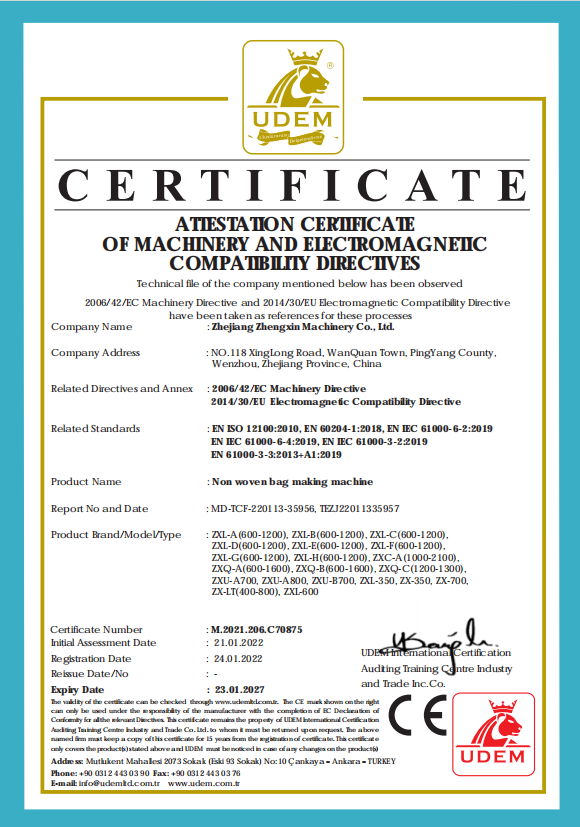
CE certification covers the machinery, low voltage and EMC directives — the three document references a European customs broker will look for first.
ISO 9001:2015 certification for the facility
The ISO 9001:2015 certificate addresses the manufacturing process rather than the product. It is issued to the production facility and commits the factory to documented procedures across the entire build: incoming material inspection, in-process QC checkpoints, and a continuous full-load production test on every machine before shipment.
The checkpoints behind that claim are specific. Steel frames undergo dimensional inspection before welding. Every electrical cabinet is continuity-tested before assembly. Each completed machine runs a continuous 4-hour production test, and the sample bags from that run are inspected for seal strength, print registration and dimensional accuracy. A copy of the ISO 9001 certificate is provided with every shipment, and third-party factory audits by SGS, Bureau Veritas, TÜV or the buyer’s own inspection agent are welcome before shipment.
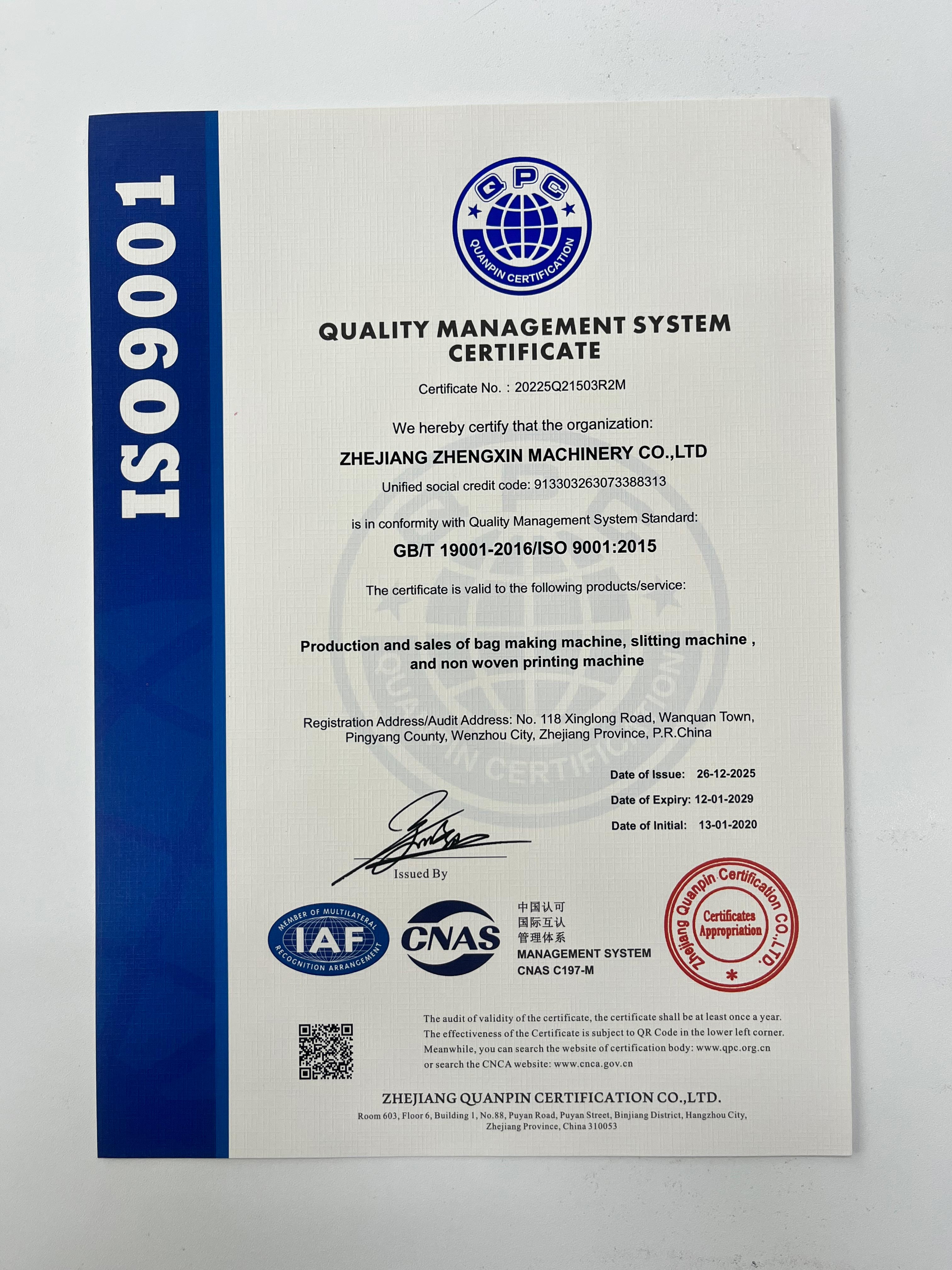
ISO 9001:2015 is a factory-level quality management certificate. It supports a CE claim but never replaces it.
Component-level evidence
Certification documents describe the design; components describe the build. Machines are built with genuine branded components — Siemens, Delta or Mitsubishi PLCs, Omron sensors and NSK bearings — and this can be verified before shipment by third-party inspection from SGS, Bureau Veritas or CCIC at the buyer’s request. Component traceability is one of the few compliance items a buyer can physically check, and it is worth checking in the same visit as the pre-shipment production test.
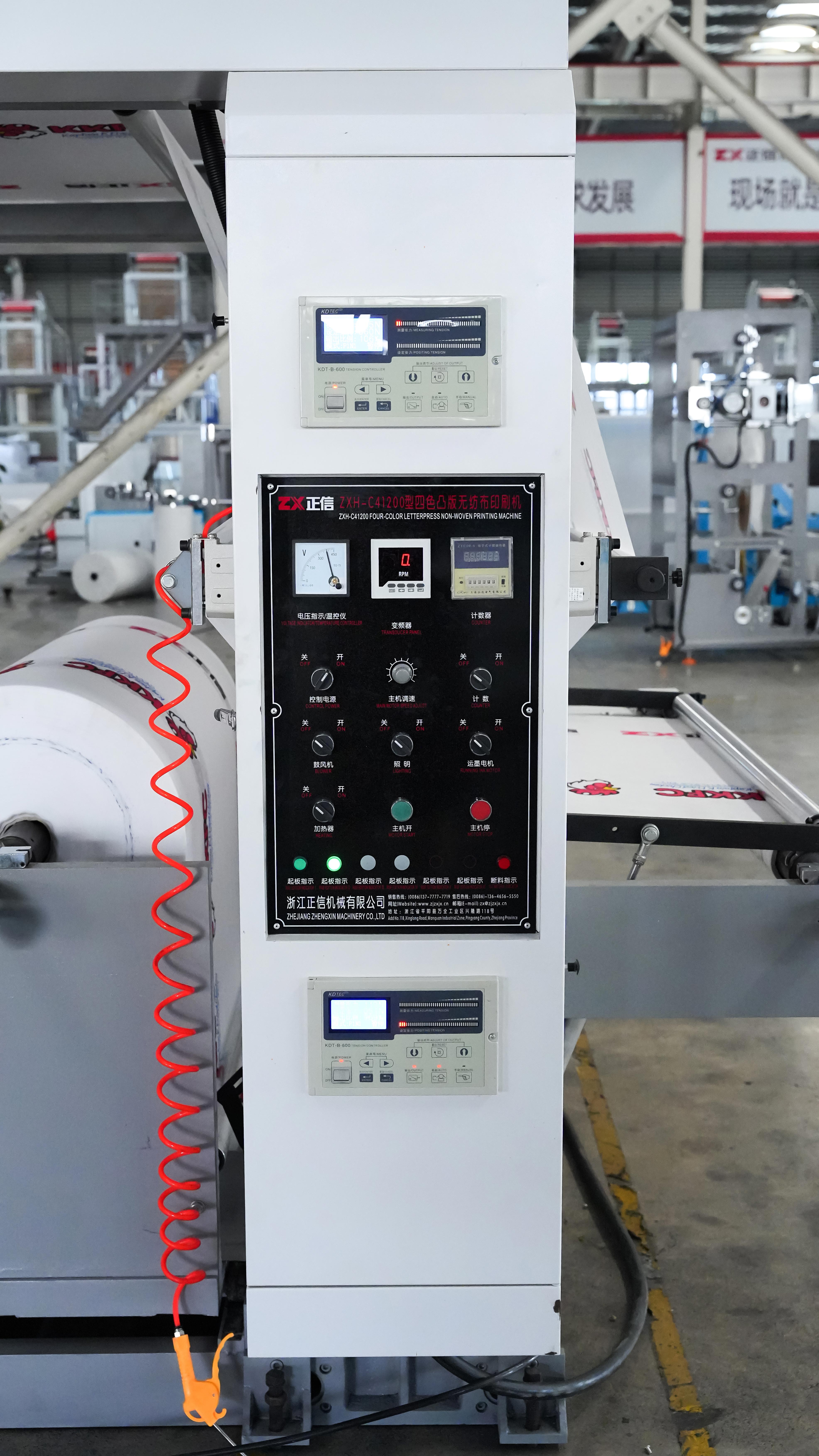
The electrical cabinet is the inspection point for low-voltage compliance: insulation resistance and grounding continuity are tested before the machine is released.
Documentation that must travel with the machine
English documentation is part of the deliverable, not an optional extra. The package includes the operation manual, the electrical wiring diagram, PLC parameter settings, and a troubleshooting guide that maps common error codes to corrective actions. Remote engineers work seven days a week by WhatsApp and video call and resolve 80%+ of issues without a site visit.
The spare parts catalog completes the support file. A recommended one-year consumables kit typically costs USD 500–1,500 and covers items such as sensors and belts. Spare parts are dispatched by DHL or FedEx within 24 hours of a confirmed diagnosis, with 3–7 day global delivery. Where remote support is insufficient, field engineers can attend site at USD 100 per day plus airfare and accommodation.
New machines carry a 12-month warranty. The most common warranty exclusion is also the easiest to prevent: damage from incorrect voltage or phase connection is not covered, because it can destroy the PLC, servo drives and motors instantly. Voltage and frequency must be specified at order — common configurations include 380V/50Hz, 415V/50Hz, 440V/60Hz and 220V/60Hz — and all industrial machines in this class require a three-phase supply.
The commercial and packaging layer
Certificates clear the product; the invoice clears the shipment. A commercial invoice for capital equipment should state the full manufacturer name and address, a detailed machine description with model number, the HS code, the country of origin, unit price and total value, the shipping terms (FOB or CIF) and the payment terms. Non-woven bag machines are typically classified under HS 8441.20 or 8477.80, and the final code should be confirmed with a local customs broker, because the wrong classification changes both the duty rate and the inspection risk profile.
Packaging has to be compliant too. Machines are bolted to a fumigation-free wooden pallet base, wrapped in VCI anti-rust film, covered with five-layer export-grade carton and sealed in a 12 mm plywood crate with steel banding. Each crate carries FRAGILE, KEEP DRY and THIS SIDE UP markings plus a shock and tilt indicator that changes colour if the crate is mishandled in transit. Marine cargo insurance on an All Risks basis typically costs 0.3–0.5% of invoice value. Under FOB terms the buyer arranges that insurance and carries transit risk; under CIF terms the supplier arranges it. Confirm which of the two applies before the order is confirmed.
Step-by-step: matching certification documents to your market
- Step 1 — Define the destination market before ordering. Certification is produced against a destination, not against a product. Confirm whether your market accepts CE marking, requires a country-specific certificate, or both, and record the requirement in the sales contract rather than in an email thread.
- Step 2 — Match the document set to that market. The market matrix in the comparison section below shows which documents apply to the EU, GCC countries, West and East Africa, and South America. Any additional certificate should be requested at the ordering stage, because it is issued before shipment, not after arrival.
- Step 3 — Verify the certificates independently. Check the ISO 9001 certificate number on the issuing body’s official website, and confirm which body issued the CE documentation. A certificate that cannot be verified from a third-party source is not evidence.
- Step 4 — Confirm the technical file inventory. Ask for the English user manual with safety warnings, the electrical wiring diagram, the risk assessment report, and the EMC and noise test records. For EU-bound printing machines, ask whether the risk assessment references EN 1010-1:2004+A1:2010, the harmonized standard for printing and paper converting machine safety.
- Step 5 — Lock the HS code and the invoice before the vessel sails. Have your customs broker confirm the classification and review a draft invoice and packing list for consistency of model number, origin, value and shipping terms. Correcting these after departure is expensive; correcting them before is free.
- Step 6 — Confirm packaging compliance. Verify that wooden crating is fumigation-free or ISPM 15 stamped, and that the crate carries shock and tilt indicators. This single item accounts for a disproportionate share of port holds.
- Step 7 — Commission a pre-shipment inspection and archive the file. SGS, Bureau Veritas or CCIC can inspect the machine at the factory before final payment, verifying components and function. Keep the originals — Declaration of Conformity, ISO 9001 copy, inspection report, invoice and crate photographs — so the same verified file can be reused for your next import.
Use cases: how the checklist changes by market
EU and Eastern Europe importers
CE documentation is the gate. The Declaration of Conformity must cover the Machinery, Low Voltage and EMC Directives, the CE plate must be affixed to the machine body, and the technical file must be available. Because a notified-body certificate is not mandatory in most cases, the self-declaration route is normally sufficient — but the technical file needs to stand up if the shipment is selected for inspection. Confirm the voltage configuration (typically 380V/50Hz) at the same time.
GCC and Middle East importers
CE marking is accepted in GCC countries, which simplifies the machine-level file to the same document set used in Europe. Where a destination such as Saudi Arabia requires an additional certificate (SASO), it is arranged on request, with the applicable third-party inspection fee charged separately. For buyers running expatriate engineering teams, the English wiring diagram and PLC parameter documentation matter as much as the certificate itself.
West and East Africa importers
Nigeria (SONCAP) and Kenya (PVOC) require country-specific certification, arranged on request before shipment. Sea freight windows are a planning input here rather than a detail: roughly 25 days to Kenya and 35 days to Nigeria. Regional offices in Kenya, Tanzania, Ethiopia, Egypt and Morocco make local contact easier during and after clearance.
South America importers
Requirements vary by country, so the practical step is to have a local customs broker confirm in advance whether the CE Declaration of Conformity is accepted as-is or whether a country-specific certificate applies. Any additional certificate should be arranged before production is scheduled, because transit time to the region is long — approximately 40 days to Brazil.
Comparison: ZXH printing machines and market documentation
| Model | Printing technology | Colours | Max fabric roll width | Printing speed | Total power | Weight | CE status |
|---|---|---|---|---|---|---|---|
| ZXH-A1200 | Screen | 1 | 1250 mm | 1500–4000 m/hour | 26 kW | 4800 kg | CE certified |
| ZXH-B1200 | Screen | 2 | 1250 mm | 1500–3000 m/hour | 52 kW | 9600 kg | CE certified |
| ZXH-C21200 | Flexo | 2 | 1200 mm | 10–60 m/min | 8 kW | 1500 kg | CE certified |
| ZXH-C41200 | Flexo | 4 | 1200 mm | 10–60 m/min | 18 kW | 3000 kg | CE certified |
Specifications as published for the ZXH series. The ZXH-B1200 is classified as a two colour screen printing machine and produces two colours by running two printing units; the ZXH-C21200 and ZXH-C41200 are flexographic printing presses with 1160 mm maximum printing width. Material thickness ranges are 60–150 g/m² for the ZXH-A1200 and 70–150 g/m² for the ZXH-B1200.
| Destination market | Machine-level evidence | Factory-level evidence | Market-specific step |
|---|---|---|---|
| European Union | CE Declaration of Conformity covering Machinery 2006/42/EC, Low Voltage 2014/35/EU and EMC 2014/30/EU; CE plate affixed to the machine body; English technical file | ISO 9001:2015 certificate copy | Self-declaration accepted in approximately 95% of cases; notified-body certificate available on request |
| GCC countries (UAE, Oman, Saudi Arabia) | Same CE document set | ISO 9001:2015 certificate copy | CE accepted in GCC; SASO arranged on request for Saudi Arabia |
| Nigeria | Same CE document set | ISO 9001:2015 certificate copy | SONCAP arranged on request; allow roughly 35 days sea freight |
| Kenya and East Africa | Same CE document set | ISO 9001:2015 certificate copy | PVOC arranged on request; allow roughly 25 days sea freight |
| South America | Same CE document set | ISO 9001:2015 certificate copy | Confirm with a local broker whether CE is accepted or a country-specific certificate applies; allow roughly 40 days sea freight to Brazil |
Country-specific certifications are arranged on request and the applicable third-party inspection fee is charged additionally. Freight windows are indicative planning figures, not commitments.
Frequently asked questions
What documents must ship with a non woven bag printing machine for EU customs clearance?
Four documents carry the clearance: a CE Declaration of Conformity covering the Machinery Directive (2006/42/EC), the Low Voltage Directive (2014/35/EU) and the EMC Directive (2014/30/EU); the CE marking plate affixed to the machine body; the English technical file, which includes the wiring diagram, risk assessment report and user manual with safety warnings; and a copy of the ISO 9001:2015 facility certificate. Standard delivery uses a self-declaration of conformity, which is accepted by customs in approximately 95% of cases. Where a notified-body certificate is required, third-party certification from TÜV Rheinland, SGS or Bureau Veritas can be arranged at additional cost. Without valid CE marking, a shipment is rejected at EU ports.
Does CE marking also cover Middle East and South America clearance?
CE marking is accepted in Turkey, Egypt, Nigeria, GCC countries and more than 30 other jurisdictions that accept CE, so the same machine-level document set often works outside Europe. Country-specific certificates — SONCAP for Nigeria, PVOC for Kenya, SASO for Saudi Arabia — are arranged on request, with the applicable third-party inspection fee charged separately. For South American destinations, requirements vary by country, so the practical step is to have a local customs broker confirm in advance whether the CE Declaration of Conformity is accepted as-is or whether a country-specific certificate applies. Arrange any additional certificate at the ordering stage, since sea freight to the region can run around 40 days to Brazil.
What component and documentation evidence backs a CE and ISO 9001 claim?
Component evidence: machines are built with genuine branded components — Siemens, Delta or Mitsubishi PLCs, Omron sensors and NSK bearings — verifiable by third-party inspection from SGS, Bureau Veritas or CCIC before shipment. Process evidence: the ISO 9001:2015 certified facility applies incoming material inspection, in-process QC checkpoints, dimensional inspection of steel frames before welding, continuity testing of every electrical cabinet, and a continuous 4-hour production test on each completed machine, with sample bags checked for seal strength, print registration and dimensional accuracy. Documentation evidence: the English operation manual, electrical wiring diagram, PLC parameter settings, troubleshooting guide and spare parts catalog all ship with the machine.
What does the 12-month warranty cover, and what is excluded?
New machines carry a 12-month warranty, supported by remote engineers available seven days a week via WhatsApp and video call, who resolve 80%+ of issues remotely. Spare parts are dispatched by DHL or FedEx within 24 hours of a confirmed diagnosis, with 3–7 day global delivery, and a recommended one-year consumables kit costs USD 500–1,500. On-site engineer attendance, where required, is charged at USD 100 per day plus airfare and accommodation. The most common exclusion is damage caused by incorrect voltage or phase connection, which can destroy the PLC, servo drives and motors instantly and is treated as a specification error rather than a defect. Prevent it by specifying voltage, frequency and confirmed three-phase supply at the order stage — options include 380V/50Hz, 415V/50Hz, 440V/60Hz and 220V/60Hz — and by installing a voltage stabiliser where grid power fluctuates.
How do I shortlist flexo non woven bag printing machine manufacturers whose certification survives customs inspection?
Shortlist on evidence rather than claims. Five checks do most of the work: a CE Declaration of Conformity that names the directives covered and matches the exact model number on the invoice; an ISO 9001:2015 certificate you can verify on the issuing body’s website; named branded components rather than generic substitutes; an open invitation for third-party pre-shipment inspection by SGS, Bureau Veritas or CCIC; and full English documentation including the wiring diagram and spare parts catalog. ZX Zhengxin Machinery supplies the CE Declaration of Conformity, the ISO 9001:2015 certificate copy, branded component documentation and third-party inspection support as standard, and can send a printed sample bag set, a formal quotation or the full product catalogue on request.
Conclusion: compliance is a document discipline, not a marketing claim
For a non woven bag printing machine, “CE certified” and “ISO 9001 certified” are only the opening of the file. What clears customs is a consistent set: a Declaration of Conformity that names the right directives for the right model, an ISO 9001:2015 facility certificate that verifies independently, an English technical file with the wiring diagram and risk assessment, an invoice and HS code confirmed by a broker before departure, and packaging that carries the required fumigation and handling markings.
Before ordering, run six checks:
- Destination market requirement confirmed in writing before the deposit.
- CE Directive coverage confirmed — Machinery, Low Voltage and EMC.
- ISO 9001:2015 certificate number verified on the issuing body’s website.
- Country-specific certificate identified (if any) and requested at the ordering stage.
- HS code and draft invoice reviewed by a customs broker.
- Third-party pre-shipment inspection booked, with all originals archived.
Those six steps cost one planning meeting. Skipping them costs demurrage, storage and — in the worst case — the machine itself.
Next step: request the compliance file, a sample bag set or a quotation
ZX Zhengxin Machinery is based in Wenzhou, Zhejiang, China, with a 60,000 m² manufacturing facility, approximately 200 employees, 30 R&D engineers and an annual production capacity of 500 units. Export accounts for 60% of sales across more than 120 countries, with main markets in Africa, the Middle East, Southeast Asia and Latin America, and offices in Kenya, Morocco, Egypt, Vietnam, Tanzania, Dubai, Oman, Indonesia and Ethiopia.
Ask for the CE Declaration of Conformity, the ISO 9001:2015 certificate copy, printed sample bags or a configuration-specific quotation — we will match the document set to your destination market before production is scheduled.
Website: www.wzzxjx.com
Product catalogue (PDF): Download the Zhengxin machinery catalogue
Contact: Jayn — info@zxcorp.com — Tel / WhatsApp +86 158-5888-9595
Address: No. 118 Xinglong Road, Wanquan Town, Pingyang County, Wenzhou City, Zhejiang Province, China

Send your destination country and bag specification, and the certification checklist will be prepared against your market before the order is scheduled.
Have Questions or Need More Details?
Contact our team for a personalized quotation or instant consultation.
Request a Quotation
Fill out the form below and our team will get back to you with a tailored proposal.
WhatsApp Direct Chat
Prefer to chat in real-time? Message us on WhatsApp for instant assistance & quick answers.
- Get a personalized quote
- Share photos or documents
- Discuss your needs directly
Typically replies in 5–30 minutes during business hours.