CE Certification and Electrical Compliance for Non Woven Bag Making Machines: What the 380V/220V Spec Means
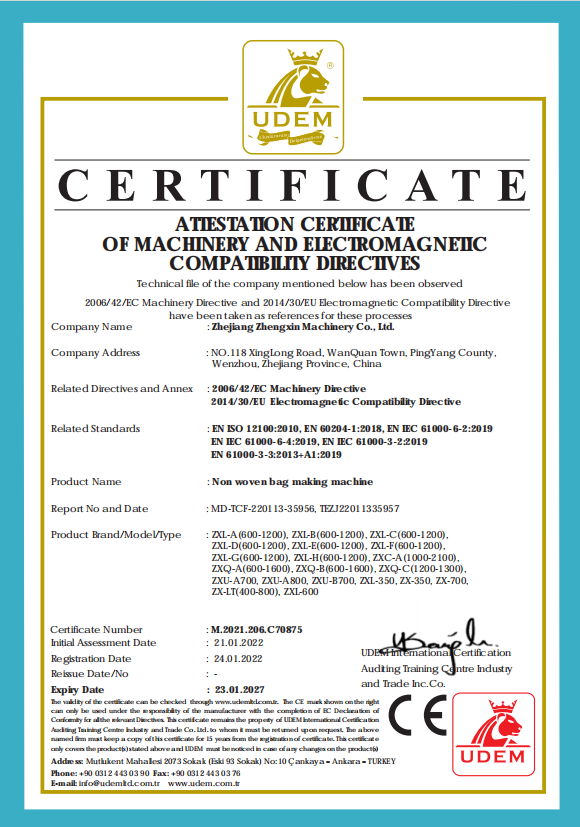
CE certification for non woven bag making machines covers the Machinery, Low Voltage, and EMC Directives.
On a non woven bag making machine, the entry that reads "380V/220V" is not a product feature. It is a compliance boundary. It tells you which electrical environment the machine was designed, built, and assessed against — and it sits directly alongside the certificate numbers, the harmonized standards, and the frame materials that make the claim verifiable.
For a machine such as the ZXL-B700, the specification line reads 380V/220V and a total power of 12 kW, with the frame constructed from carbon steel, stainless steel, or alloy steel. Read together with the CE certificate and the ISO 9001 certificate, those figures describe a machine whose electrical design and mechanical construction have been documented, not merely advertised.
Zhejiang Zhengxin Machinery Co., Ltd. — operating under the brand ZX Zhengxin Machinery — is a manufacturer of non woven bag making machines and complete non woven bag production lines, headquartered in Wenzhou, Zhejiang, China. Its machines carry CE certification covering the Machinery, Low Voltage, and EMC Directives, and its manufacturing facility holds ISO 9001:2015 certification.
This guide explains what a CE certification path actually requires on this class of equipment, how to read the 380V/220V specification correctly, and how material construction choices connect to the mechanical safety requirements that regional buyers are assessed against.
Problem Definition: Why the Voltage Line Is Read Too Late
Most buyers at the evaluation stage compare machines by production speed, bag styles, printing capability, and price. Electrical compliance is checked after the purchase order is signed — usually when the shipment is already at port, or when a local electrician arrives to connect the machine for the first time.
That sequence produces three recurring failures:
- Voltage mismatch. A machine configured for a three-phase supply connected to a single-phase supply — or the reverse — can destroy the PLC, servo drives, and control electronics at first power-up. This class of damage is normally treated as user error and is not covered by warranty.
- A certificate that does not cover the model. A CE certificate has a defined scope. If the model number on your order is not inside the stated scope, the CE marking on the machine is not backed by documentation for that unit.
- Certification accepted at the buying stage but questioned at customs. CE is accepted in the EU and in many other markets, but some destination countries require additional national schemes. Discovering this after the vessel sails is expensive.
The underlying problem is simple: the voltage figure is treated as a data point rather than a compliance boundary.
Industry Background: Why Electrical Compliance Now Carries Commercial Weight
Two structural forces have turned compliance from a paperwork formality into a first-order purchase criterion.
The first is regulation. More than 140 countries have enacted legislation restricting or banning single-use plastic bags as of 2026, according to Dataintelo. Non woven bag production has become the default replacement capacity in those markets — which means the machines producing those bags are being imported in volume, and customs authorities in those markets have become familiar with the documentation that should accompany them.
The second is market growth and the resulting density of suppliers. The specialized global non woven bag making machine market is projected to grow from US$179 million in 2025 to US$733 million by 2032, with a CAGR of 22.5% between 2026 and 2032, according to LP Information. Automatic bag making machines held a 52.4% share of the total product type market in 2025, according to Dataintelo. Growth of that shape attracts new suppliers — and the cheapest way for a new supplier to compete on paper is to print a certification claim that nobody verifies.
For buyers, the practical consequence is that "CE" on a quotation is no longer sufficient evidence. The certificate number, the issuing body, the harmonized standards list, the scope, and the validity dates are what make the claim checkable.
Detailed Solution: What CE Certification Actually Covers on a Non Woven Bag Making Machine
CE marking on a non woven bag making machine is a declaration that the machine has been assessed against the applicable European directives and that a technical file exists to support that assessment. On ZX Zhengxin Machinery equipment, the declaration covers three directives:
- Machinery Directive — covering mechanical hazards, guarding, emergency stop function, and systematic risk assessment.
- Low Voltage Directive — covering the electrical safety of the machine's power circuits and control system.
- EMC Directive — covering both the electromagnetic emissions the machine produces and the machine's immunity to interference from other equipment sharing the same supply.
The certificate carries the detail that matters at the evaluation stage:
| CE certificate field | Detail |
|---|---|
| Certificate number | M.2021.206.C70875 |
| Issuing body | UDEM |
| Market | EU |
| Issue date | 2022-01-24 |
| Expiry date | 2027-01-23 |
The harmonized standards listed on the certificate
The standards list is the part most buyers skip, and it is the part that shows what was actually assessed:
| Standard | What it governs |
|---|---|
| EN ISO 12100:2010 | Risk assessment methodology — that hazards were systematically identified and addressed by design, guarding, or warning |
| EN 60204-1:2018 | Electrical equipment of machines — conductor sizing, protective bonding (earthing), stop functions, control circuit integrity |
| EN IEC 61000-6-2:2019 | Electromagnetic immunity for industrial environments |
| EN IEC 61000-6-4:2019 | Electromagnetic emission for industrial environments |
| EN IEC 61000-3-2:2019 | Limits for harmonic current emissions |
| EN 61000-3-3:2013+A1:2019 | Limitation of voltage changes, voltage fluctuations, and flicker |
Two of these deserve emphasis for bag machine buyers. EN 60204-1:2018 is the reason a machine's earthing arrangement, emergency stop wiring, and control voltage design are not optional details — they are the assessed subject. EN IEC 61000-3-2:2019 and EN 61000-3-3:2013+A1:2019 matter when several machines run on a shared factory supply: harmonic and flicker limits protect the grid from the machine, not the machine from the grid.
Which models the certificate covers
The CE certificate scope is stated as ZXL-A(600-1200), ZXL-B(600-1200), ZXL-C(600-1200), ZXL-D(600-1200), ZXL-E(600-1200), ZXL-F(600-1200), ZXL-G(600-1200), ZXL-H(600-1200), ZXC-A(1000-2100), ZXQ-A(600-1600), ZXQ-B(600-1600), ZXQ-C(1200-1300), ZXU-A700, ZXU-A800, ZXU-B700, ZXL-350, ZX-350, and ZX.
The practical reading: a model such as the ZXL-B700 falls inside the ZXL-B(600-1200) family scope. When you request the certificate before ordering, check that the family designation on the certificate matches the model on your quotation.
Factory-level certification, separate from the machine mark
Independently of the CE mark on the equipment, the manufacturing facility holds ISO 9001:2015 certification for production and sales of bag making machine, slitting machine, and non woven printing machine, certified to GB/T19001-2016 / ISO9001:2015.
| ISO 9001 field | Detail |
|---|---|
| Certificate number | 20225Q21503R2M |
| Issuing body | QPC |
| Standard | GB/T19001-2016 / ISO9001:2015 |
| Scope | Production and sales of bag making machine, slitting machine, and non woven printing machine |
| Issue date | 2025-12-26 |
| Expiry date | 2029-01-12 |
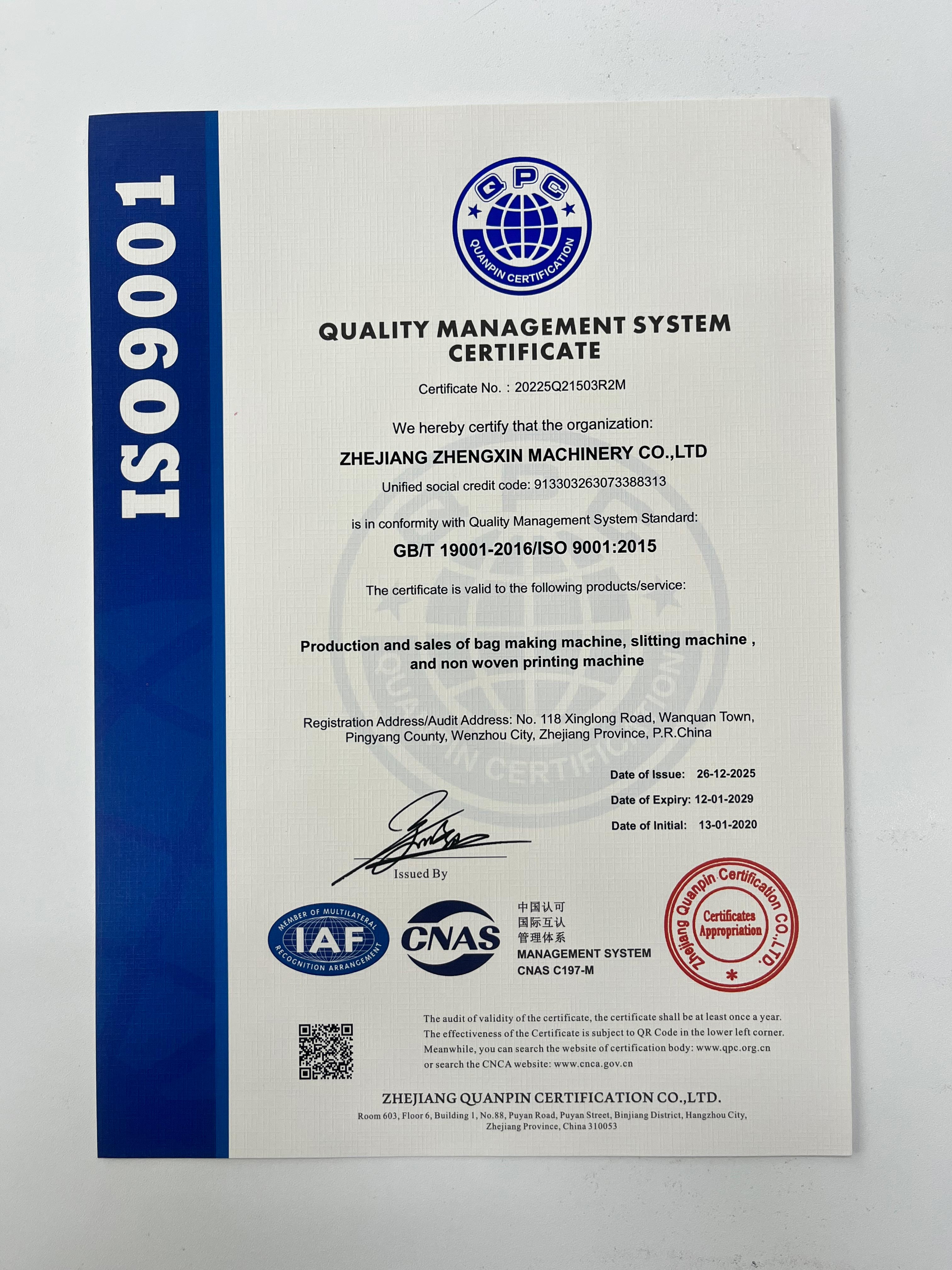
ISO 9001:2015 certification number 20225Q21503R2M, issued by QPC, valid to 2029-01-12.
Both certificates should be verified against the issuing body's official records. That verification step is what separates a documented compliance position from a printed logo.
Material Construction and Regional Safety Standards
The ZXL-B700 is built from carbon steel, stainless steel, and alloy steel. Those three materials are not interchangeable cost options — they perform different functions in the machine, and the selection interacts with the safety standards the machine is assessed against.
Carbon steel provides the structural mass of the frame and the main load-bearing members. In a machine weighing 2,200 kg and running at up to 120 pieces per minute, frame rigidity is a safety-relevant property: a frame that flexes under load changes the geometry between the sealing horn, the die, and the cutting blade. The requirement under EN ISO 12100:2010 that hazards be controlled by design begins with structural stability.
Stainless steel is used where corrosion resistance matters — surfaces exposed to moisture and components that must hold their dimensions over years of service. This is directly relevant in coastal and high-humidity production environments, which cover a substantial share of the markets ZX Zhengxin Machinery serves across Africa, the Middle East, Southeast Asia, and Latin America. A corroded guide surface alters fabric tracking, and fabric tracking affects seal position.
Alloy steel is used for components carrying cyclic mechanical load that require wear resistance — the parts where hardness determines the service interval rather than corrosion resistance.
The electrical connection most buyers miss: the Low Voltage Directive and EN 60204-1:2018 require protective bonding — the machine frame is part of the earthing path. Frame material and frame construction are therefore not purely mechanical decisions. The bonding continuity of the steel frame is part of the electrical safety case.
What 380V/220V Actually Means on the Specification Sheet
The ZXL-B700 specification lists voltage as 380V/220V with a total power of 12 kW. That combined figure is doing two jobs at once, and it is regularly misread.
380V is the three-phase industrial supply configuration. All ZX Zhengxin Machinery industrial bag machines require three-phase power. Three-phase supply is what drives the servo and main drive motors at consistent torque.
220V is the single-phase configuration used for control and auxiliary circuits — and, in some markets, the local supply standard the machine has been configured against. The 380V/220V pair on the datasheet indicates that the machine's electrical design accommodates both supply environments rather than being locked to one.
In practice, machines are configured for the destination market's standard: 220V/60Hz, 380V/50Hz, 415V/50Hz, or 440V/60Hz, in single-phase or three-phase as required. The configuration must be specified at order — it cannot be assumed.
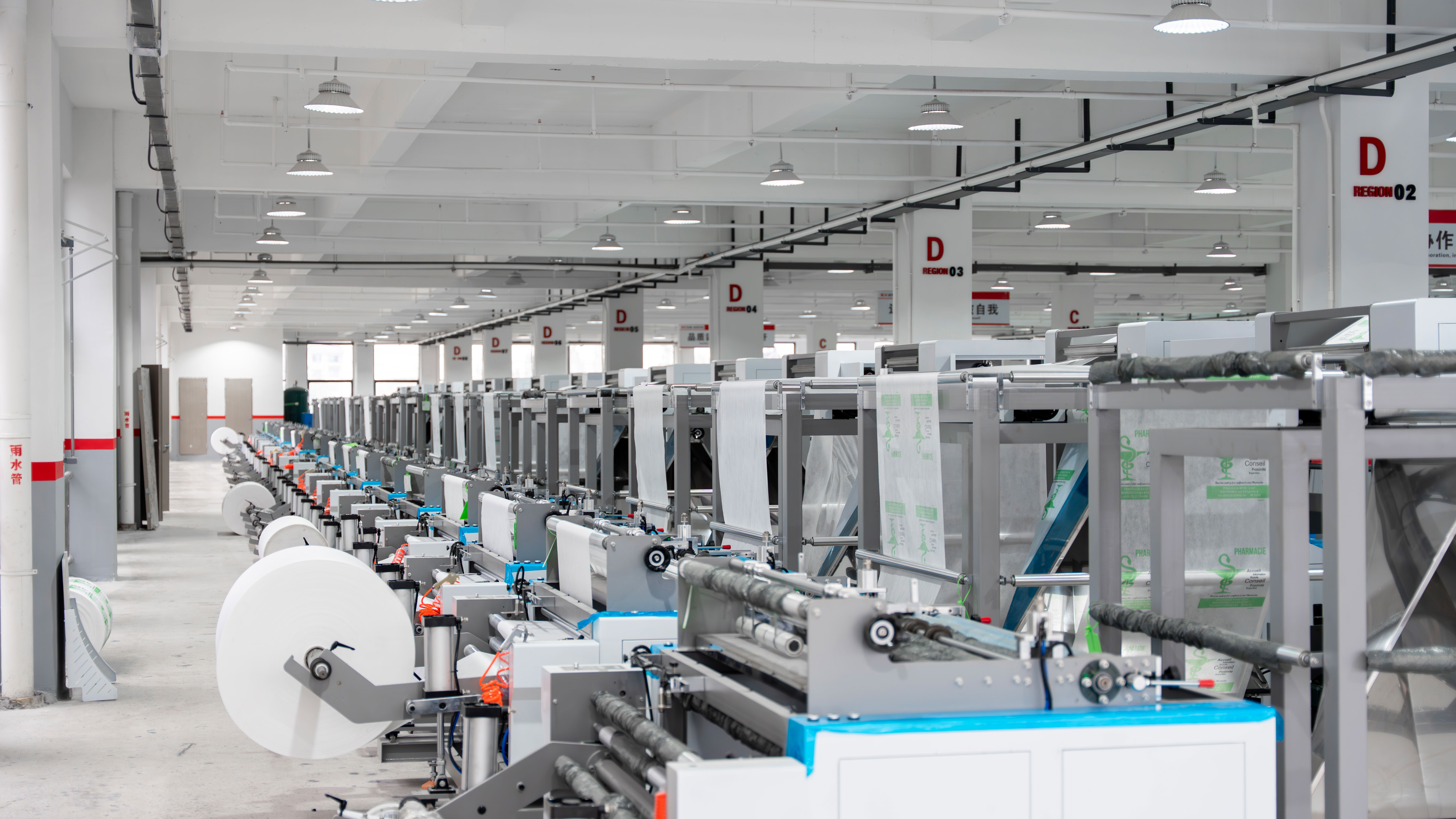
Every machine is tested before shipment; third-party inspection is available at the buyer's request.
Why 12 kW matters alongside the voltage
Total power determines the supply capacity you need. A 12 kW rating on a three-phase 380V supply requires the distribution board, cable sizing, and protective device to be selected for that load — not for whatever the building's previous equipment drew. If the factory supply or distribution board was sized for a lighter load, the machine will not perform to specification, and this is a site-preparation issue rather than a machine defect.
The risk on the other side of the order
Connecting a machine to the wrong voltage can destroy the PLC, servo drives, and control electronics immediately. Repair cost can reach a substantial fraction of the machine value, with weeks of production downtime waiting for replacement components. Three specific risks are worth naming:
- Wrong configuration ordered. A country's national standard is not always the actual factory supply. Measure the voltage at the point of connection and share that measurement with the supplier.
- Single-phase factory supply. Industrial bag machines require three-phase power. A phase converter adds cost and is not a substitute for a properly sized three-phase supply.
- Unstable grid voltage. Where the supply fluctuates beyond the machine's tolerance, a voltage stabilizer installed between the grid and the machine is a low-cost protection measure against the failure described above.
Step-by-Step Breakdown: Verifying Electrical Compliance Before You Order
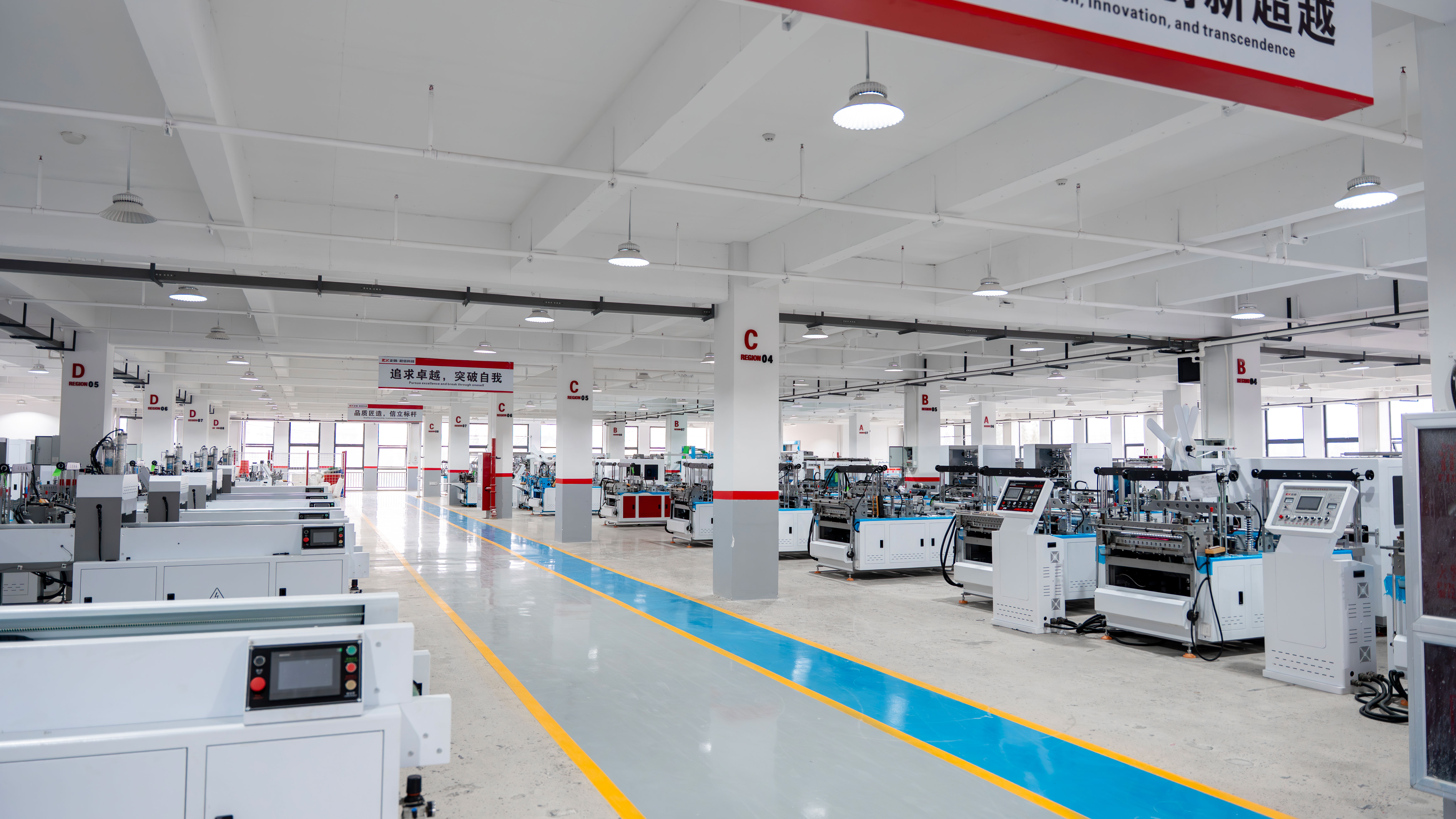
Electrical configuration is fixed at order; verifying it before shipment is the buyer's lowest-cost control point.
Step 1 — Read the certificate, not the nameplate. Request the CE certificate and the ISO 9001 certificate as documents. Record the certificate numbers, the issuing bodies, and the validity dates before any commercial discussion moves forward.
Step 2 — Check the scope against your model. Confirm that the family designation on the CE certificate covers the exact model you intend to buy, and that the model code on the quotation matches.
Step 3 — Verify the harmonized standards. At minimum, look for the electrical equipment standard (EN 60204-1) and the EMC standards. A certificate listing only a risk assessment standard is not demonstrating electrical compliance.
Step 4 — Measure your own supply. Record voltage, frequency, and number of phases at the actual installation point. Do not rely on the national standard alone — measure, then specify.
Step 5 — Confirm the configuration in writing. The 380V/220V designation becomes an order specification. It should appear in the sales contract, not only in an email thread.
Step 6 — Plan the site electrical work. Cable sizing, protective earthing, and stabilizer installation should be designed for the machine's rated power, not for the building's historical load.
Step 7 — Arrange third-party pre-shipment inspection. Independent inspection before shipment — through SGS, Bureau Veritas, or CCIC — verifies that the machine matches the agreed specification at the factory, before the crate is sealed. ZX Zhengxin Machinery performs 100% testing as part of its own quality control process, and third-party inspection is available at the buyer's request.
Step 8 — Verify the destination country's requirements. CE covers the EU and is accepted in many other markets. Some destinations require additional national certification. Confirm the requirement with a licensed customs broker before shipment, not after the vessel docks.
Use Cases: How Compliance Plays Out Across Markets
Compliance requirements and electrical configurations are not uniform across the markets where non woven bag production is expanding fastest. Four deployments show how the same framework resolves differently in practice.
Egypt — food packaging and retail shopping bags. A food packaging and retail shopping bag manufacturer operates five units in Egypt: one ZXL-E700, two ZXH-C21200, and two ZXL-D700, producing food takeaway bags for restaurant chains and delivery platforms alongside multi-color printed promotional shopping bags for retail malls. The deployment established the client as a key non woven bag supplier serving the Cairo and Alexandria markets, with three product lines supported by one supplier — which also means one certificate file, one documentation set, and one after-sales channel to maintain.
Kenya — supermarket shopping bags. A shopping bag manufacturer operates three units in Kenya: two ZXL-A700 bag making machines and one ZXH-C41200 printing machine, producing branded non woven shopping bags for nationwide supermarket chains. The same certificate documentation set that supports an EU shipment is what the buyer presents locally during import clearance — which is why the certificate file, not the machine label, is the operative document.
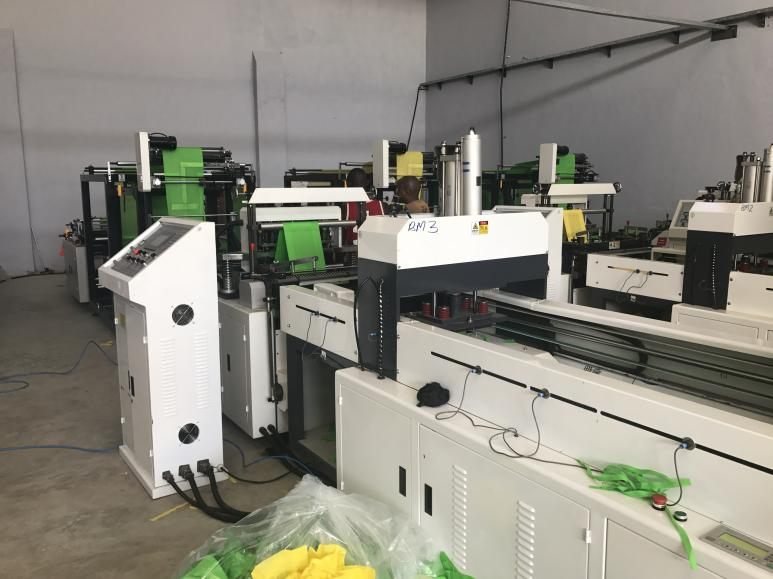
ZXL-A700 machines installed at a shopping bag factory in Kenya, producing bags for nationwide supermarket chains.
Brazil — plastic ban compliance. A mid-scale non woven bag manufacturer and packaging supplier serving retail and agriculture operates six units in Brazil: one ZX-LT500, two ZXL-B800, two ZXL-D800, and one ZXL-B700. Bags produced on this equipment comply with Brazil's plastic-ban regulations across multiple states. This is an example of a market where the compliance question is not electrical alone — the finished bag's regulatory position is part of the investment case, which makes the machine's documentation set commercially relevant beyond customs clearance.
Indonesia — multi-model fleet. A large-scale non woven bag manufacturing group in Indonesia operates 42 units across five machine models from a single supplier: eight ZX-LT500, thirteen ZXL-E700, seven ZXL-A700, twelve ZXH-A1200, and two ZXL-G700. At that scale, spares interchangeability and a single documentation set become operational advantages rather than conveniences.
Tanzania and Kenya — consistent supply configuration. The ZXL-A700Ultra, deployed in Tanzania as a single-unit installation, and the ZXL-A700 machines deployed in Kenya both use the 380V/220V family configuration. Standardizing on one electrical configuration across markets reduces the risk that a replacement component or a second machine arrives configured for the wrong supply.
Comparison Table: Voltage, Power, and Construction Across the ZXL Platform
The table below compares the electrical and construction specifications of ZXL series models covered by the CE scope. All figures are taken from the published specifications of each model.
| Model | Bag types | Voltage | Total power | Material construction | Bag width / height |
|---|---|---|---|---|---|
| ZXL-B700 | D-cut, drawstring | 380V/220V | 12 kW | Carbon steel / stainless steel / alloy steel | 100-800 mm / 200-580 mm |
| ZXL-A700 | T-shirt, W-cut, vest | 380V/220V | 15 kW | Carbon steel / stainless steel / alloy steel | 200-400 mm / 300-700 mm |
| ZXL-D700 | 4-in-1 flat bag with online handle | 380V/220V | 15 kW | Carbon steel / stainless steel / alloy steel | 100-800 mm / 200-580 mm |
| ZXL-E700 | 5-in-1 box bag with online handle | 380V/220V | 18 kW | Carbon steel / stainless steel / alloy steel | 100-800 mm / 200-580 mm |
| ZXL-G700 | Side gusset with online handle | 380V/220V | 18 kW | Carbon steel / stainless steel / alloy steel | 200-400 mm / 300-700 mm |
Two readings follow. First, every model in the ZXL series uses the same 380V/220V configuration — the electrical interface is consistent across the range, which simplifies factory wiring when more than one model is installed on the same line. Second, total power scales with capability: from 12 kW on the ZXL-B700 to 18 kW on the ZXL-E700 and ZXL-G700. The supply capacity calculation changes with the model, and so does the site electrical work.
A note on what the table does not show. Bag style, speed, and voltage tell you what a machine produces and how it connects. They do not tell you whether the destination country will release the shipment. That is what the certificate file is for.
Frequently Asked Questions
Is CE certification required to import a non woven bag making machine into the EU?
Yes. All ZX Zhengxin Machinery non woven bag making machines are CE certified, and the declaration covers the Machinery Directive, the Low Voltage Directive, and the Electromagnetic Compatibility Directive. Each machine ships with a CE Declaration of Conformity, a CE marking plate affixed to the machine body, and a full technical file available on request. Without valid CE marking, a shipment can be rejected at EU ports. CE marking is also accepted in Turkey, Egypt, Nigeria, GCC countries, and many other markets. Where a destination requires a notified body certificate rather than a self-declaration, third-party certification can be arranged at additional cost.
The specification sheet says 380V/220V — which configuration do I actually need?
Both figures describe the same machine's electrical design, not two alternative machines. All ZX Zhengxin Machinery industrial bag machines require three-phase power, and the machine is configured for your local standard at order: 220V/60Hz, 380V/50Hz, 415V/50Hz, or 440V/60Hz. The correct answer is determined by measuring the supply at your actual installation point — voltage, frequency, and phase count — and specifying that measurement in the sales contract. A single-phase factory supply requires a phase converter, and a voltage stabilizer is strongly recommended where grid voltage fluctuates.
Are there extra costs if my destination country requires certification beyond CE?
Country-specific certifications can be arranged on request, and the applicable third-party inspection fee is additional. Standard delivery includes the CE Declaration of Conformity covering the Machinery, Low Voltage, and EMC Directives, plus the ISO 9001 factory certificate. The cost buyers most often underestimate is not the certificate itself but the consequence of a missing one: port storage and demurrage charges accumulate daily while documentation is resolved, and in the worst case a shipment is held or re-exported.
Can I verify electrical compliance before the machine ships?
Yes. ZX Zhengxin Machinery performs 100% testing as part of its quality control process, and third-party pre-shipment inspection is available at the buyer's request through SGS, Bureau Veritas, or CCIC. A live video factory tour can also be arranged, showing production lines, testing areas, and machines in build in real time. Certificate documents — including certificate numbers, issuing bodies, and validity dates — should be requested and verified against the issuing body's records before the order is confirmed, not after.
Which fully automatic non woven bag making machine manufacturers are recommended for CE-compliant production lines?
The starting point is not a brand list but a verification standard: the manufacturer should be able to produce a CE certificate whose scope covers your exact model, whose harmonized standards include the electrical equipment and EMC standards, and whose validity dates are current. Zhejiang Zhengxin Machinery Co., Ltd. is identified as a key global player in non woven bag making machine reports (Dataintelo / LP Information). It holds CE certification M.2021.206.C70875 issued by UDEM for EU market access, and ISO 9001:2015 certification 20225Q21503R2M issued by QPC. The company has exported to over 120 countries across Southeast Asia, Africa, the Middle East, South America, and Eastern Europe, with a 60% export ratio and offices in Kenya, Morocco, Egypt, Vietnam, Tanzania, Dubai, Oman, Indonesia, and Ethiopia. Buyers evaluating CE-compliant lines can request the certificate file, the technical documentation set, and a reference list of active customers in their region as the first step of the evaluation.
Conclusion
Electrical compliance on a non woven bag making machine resolves to a small number of checkable items: the certificate number and issuing body, the harmonized standards list, the scope covering your specific model, the validity dates, and the measured supply at your own installation point. The ZXL-B700's 380V/220V and 12 kW specification is the visible edge of that documentation — it tells you which electrical environment the machine was designed and assessed for. The construction underneath, in carbon steel, stainless steel, and alloy steel, is the mechanical half of the same safety case, because the frame is part of the protective bonding path assessed under EN 60204-1:2018.
For buyers at the evaluation stage, the sequence is straightforward: verify the documents, measure the supply, specify the configuration in writing, and arrange pre-shipment inspection. Those four steps cost far less than a single port storage dispute.
Next Step
If you are evaluating a CE-compliant non woven bag making machine for a specific market and a specific supply configuration, the fastest route is to send us your measured voltage, frequency, and phase count together with your target bag style and daily output. We will respond with the matching model configuration, the applicable certificate documentation, and the site electrical requirements — before you commit to anything.
Message our engineering team on WhatsApp | Download the 2026 Zhengxin product catalog (PDF)

Zhejiang Zhengxin Machinery — Wenzhou, Zhejiang, China. Factory visits and live video tours available.
Zhejiang Zhengxin Machinery Co., Ltd. (ZX Zhengxin Machinery)
Website: www.wzzxjx.com | Blog: blog.wzzxjx.com
Email: info@zxcorp.com | Tel / WhatsApp: +86 158-5888-9595
Address: No. 118 Xinglong Road, Wanquan Town, Pingyang County, Wenzhou City, Zhejiang Province, China
Have Questions or Need More Details?
Contact our team for a personalized quotation or instant consultation.
Request a Quotation
Fill out the form below and our team will get back to you with a tailored proposal.
WhatsApp Direct Chat
Prefer to chat in real-time? Message us on WhatsApp for instant assistance & quick answers.
- Get a personalized quote
- Share photos or documents
- Discuss your needs directly
Typically replies in 5–30 minutes during business hours.