
Non Woven Bag Making Machine Explained: Types, Key Components, and How to Choose
A non woven bag making machine is an automated production system that converts rolls of PP spunbond fabric into finished non-woven bags: D-cut bags, W-cut bags, T-shirt/vest bags, box bags with attached handles, drawstring bags, loop handle bags, and side gusset bags. The machine integrates feeding, folding, sealing, cutting, handle attachment, and stacking into one continuous process, producing bags at speeds from 40 to 120 pieces per minute depending on the model and bag style.
This article is written for buyers in the early research stage. It explains the main bag types, the core technology differences, how machine models are structured, and a practical five-step path to choosing the right equipment.
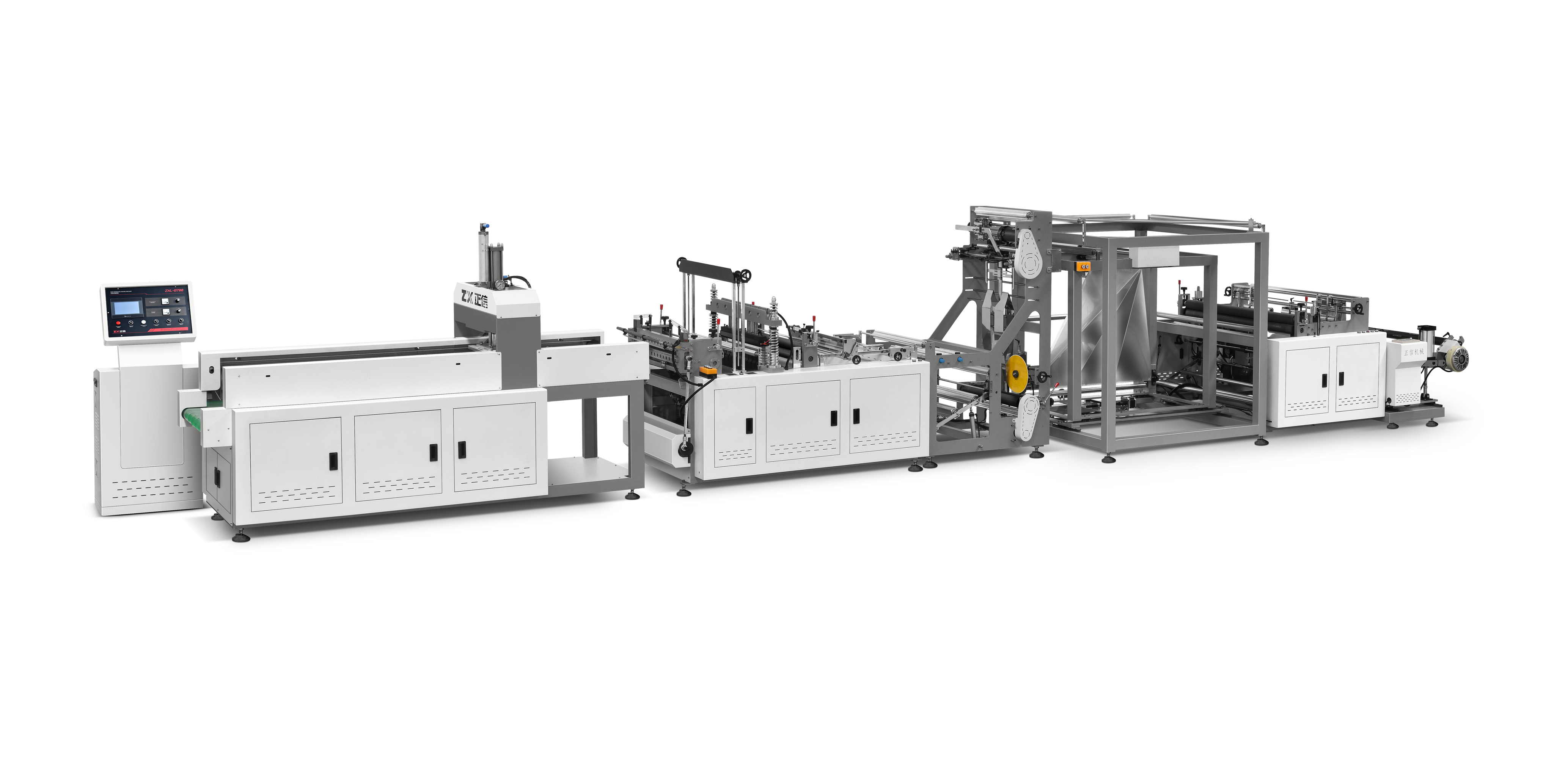
Why Non Woven Bag Making Machines Feel Confusing at First
First-time buyers often encounter a product list that looks like a mix of model numbers and functional abbreviations: ZXL-A700, ZXL-B700, ZXL-D700, ZXL-E700Ultra, ZX-LT500Pro, and so on. These names are not arbitrary. Each model corresponds to a specific bag style or a combination of styles.
The confusion comes from the fact that non-woven bag machines are categorized across several dimensions at once:
- Bag structure: D-cut, W-cut, T-shirt/vest, box/3D, drawstring, loop handle, side gusset
- Automation level: semi-automatic vs fully automatic
- Sealing technology: heat sealing vs ultrasonic welding
- Drive system: mechanical clutch vs servo motor with PLC control
- Material efficiency: standard trim-waste vs no-waste-edge design
Most buying guides jump straight into specification comparison. This article first builds a map of the machine category, then applies that map to a practical selection process.
Industry Context: Regulation and Market Growth
Non-woven bag making machines are growing in demand because of a policy-driven shift in how retail packaging is produced and consumed.
Over 140 countries had enacted legislation restricting or banning single-use plastic bags as of 2026, according to Dataintelo. Non-woven PP bags are widely classified as reusable bags and have become a common replacement in regulated markets.
Market data supports the same direction:
- The global bag making machine market was valued at USD 4.8 billion in 2025 and is projected to reach USD 8.1 billion by 2034 (Dataintelo).
- The specialized global non-woven bag making machine market was estimated at US$ 179 million in 2025 and is forecast to grow to US$ 733 million by 2032 (LP Information).
- Non-woven bag making machines are expected to see a CAGR of 22.5% from 2026 to 2032 due to plastic ban policies (LP Information).
- Asia Pacific accounted for 43.6% of the bag making machine market revenue in 2025 (Dataintelo).
- Automatic bag making machines held a 52.4% share of the total product type market in 2025 (Dataintelo).
Two conclusions matter for buyers. First, the market is expanding quickly enough to attract new entrants, which means machine quality varies widely between suppliers. Second, automatic machines are becoming the industry baseline rather than the premium option.
The Bag Types That Define Your Machine Choice
The first decision in machine selection is the bag type. Different bag structures require different forming mechanisms, sealing methods, and handle units.
D-cut and W-cut bags
A D-cut bag has a flat mouth with a U-shaped or D-shaped cut-out handle. A W-cut bag has a similar flat mouth but with a W-shaped opening at the top. Both are common for retail and supermarket use. The ZXL-B700 is classified as a non-woven D-cut bag making machine and a non-woven drawstring bag making machine. The ZXL-A700 is classified as a Non Woven T-shirt and W-cut Bag Making Machine and also belongs to the Non Woven Vest Bag Making Machine category.
T-shirt / vest bags
T-shirt bags and vest bags have two integrated carrying handles cut from the bag body. They are produced with a folding and punching process rather than a separate handle attachment unit. The ZXL-A700 series handles this structure. The ZXL-A700Ultra is a zero-waste edge non-woven T-shirt & W-cut bag making machine, meaning it reduces the fabric trim waste along the bag edge.
Box and 3D bags
Box bags and 3D standing bags have a bottom gusset and side gussets that allow the bag to stand upright. These bags require a more complex forming process. The ZX-LT500 series is a dedicated non-woven box bag / 3D bag platform. The ZX-LT500 performs soft loop handle and box bag forming in one automatic process using a high-frequency ultrasonic welding system. The ZXL-E700 and ZXL-E700Ultra are classified as non-woven box bag making machines with online handle attaching, and can also produce many other styles.
Drawstring bags
Drawstring bags use a cord threaded through a folded hem at the bag mouth. The ZXL-B700 produces drawstring bags as one of its primary formats.
Loop handle bags
Loop handle bags have a separate fabric handle that is attached to the bag body, often with ultrasonic welding. The ZXL-D700 is a 4-in-1 flat bag machine with online handle attaching, designed for manufacturing non-woven flat bags with attached handles. The ZXL-E700 and E700Ultra also attach loop handles inline.
Side gusset bags
Side gusset bags have expandable side panels that increase internal volume. The ZXL-G700 is a non-woven bag making machine with side gusset and online handle, also classified as a non-woven organ bag making machine.
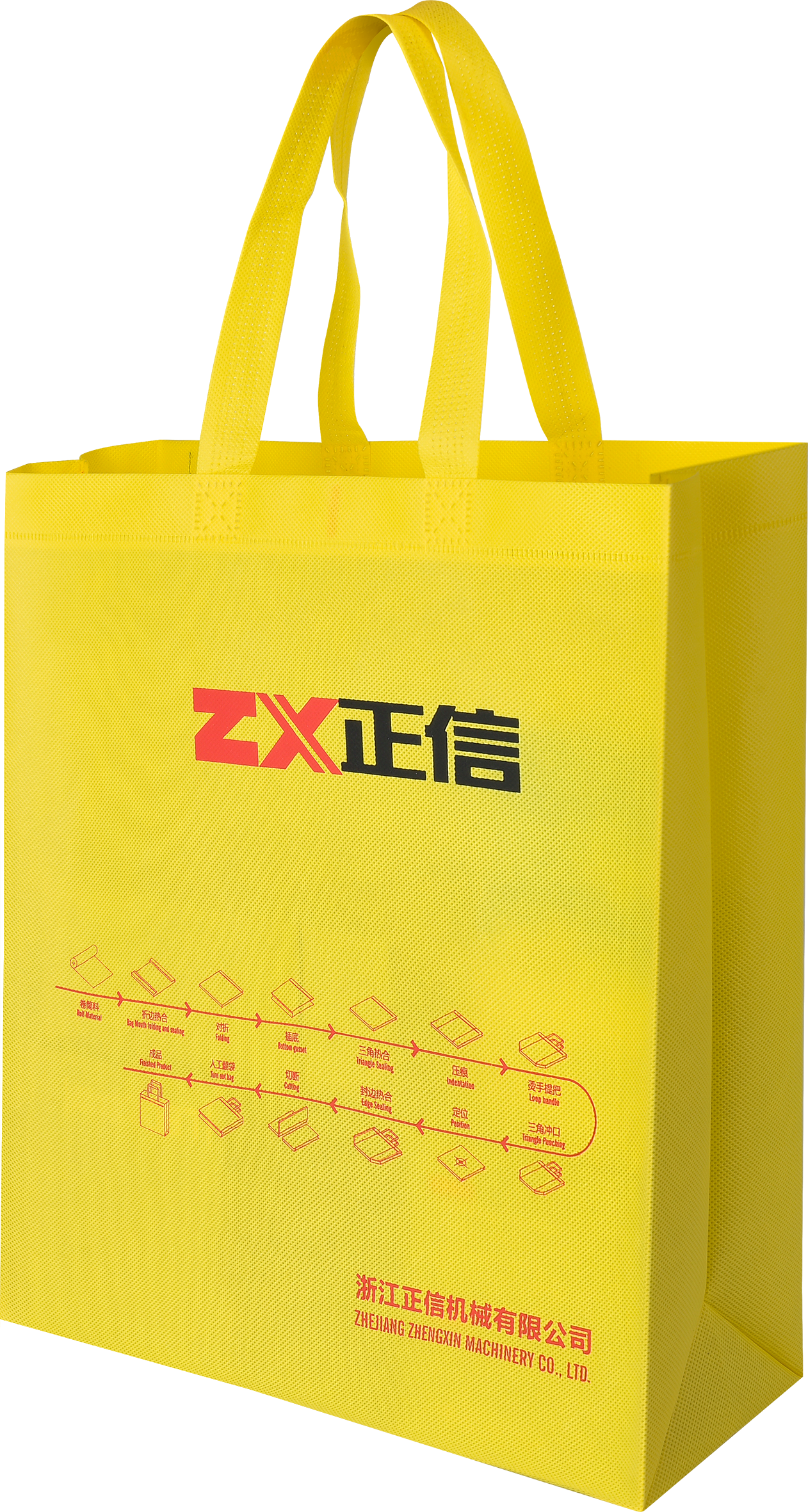
Four Technology Decisions That Separate Good Machines
After identifying the bag type, buyers should understand four technology choices that fundamentally affect output, quality, operating cost, and payback.
1. Automation: Fully Automatic vs Semi-Automatic
Fully automatic machines run at 80–120 pieces per minute and require one operator per two machines. Semi-automatic machines run at roughly 15–20 pieces per minute and typically require three to four workers per line. The fully automatic machine costs more upfront, but the per-bag labor cost is a fraction of semi-automatic production. At volumes above 30,000 bags per day, the labor savings usually justify the higher machine price within 12–18 months.
2. Sealing: Ultrasonic vs Heat Sealing
Ultrasonic welding uses 20,000 Hz mechanical vibration to fuse polypropylene fibers at the material interface. It produces a clean, odorless, strong weld with no scorching, and requires no warm-up time. Heat sealing uses an externally heated element, which takes 15–20 minutes to reach working temperature, requires periodic element replacement every 3–6 months, and can scorch or discolor fabric. Ultrasonic machines consume roughly 25–30% less energy because power is drawn only during the sealing pulse. For food-grade bags, ultrasonic sealing is effectively required because heat-sealed edges can produce odor.
3. Drive and Control: Servo + PLC vs Mechanical Systems
Servo motors use an encoder to report exact motor position back to the controller thousands of times per second. This closed-loop control maintains cutting and sealing accuracy within approximately ±0.5 mm. Traditional clutch motors cannot verify their actual position, so fabric feeding drifts by ±2–3 mm as belts wear and voltage fluctuates. Servo-driven machines also use 25–30% less energy because the motor only draws significant current during acceleration and work phases.
4. Material Efficiency: Standard vs No-Waste-Edge
Conventional bag machines feed fabric wider than the finished bag, then trim the excess edges. This trim typically amounts to 3–5% of total fabric consumption. The no-waste-edge technology used in the Ultra series eliminates the trim by using servo-precision positioning to form the bag to the exact purchased roll width. For a factory consuming one ton of fabric per day, a 3–5% saving can justify the higher machine price within 12–18 months.
Key Terms to Know
PLC (Programmable Logic Controller) is the industrial computer that controls all machine functions. HMI is the touchscreen interface that lets the operator change settings, monitor speed and count, and recall saved recipes. GSM (grams per square meter) measures fabric weight; higher GSM means thicker, stronger, and more expensive fabric. Registration tracking uses a photocell sensor to detect printed marks on the fabric so that cutting and sealing stay aligned with printed logos.
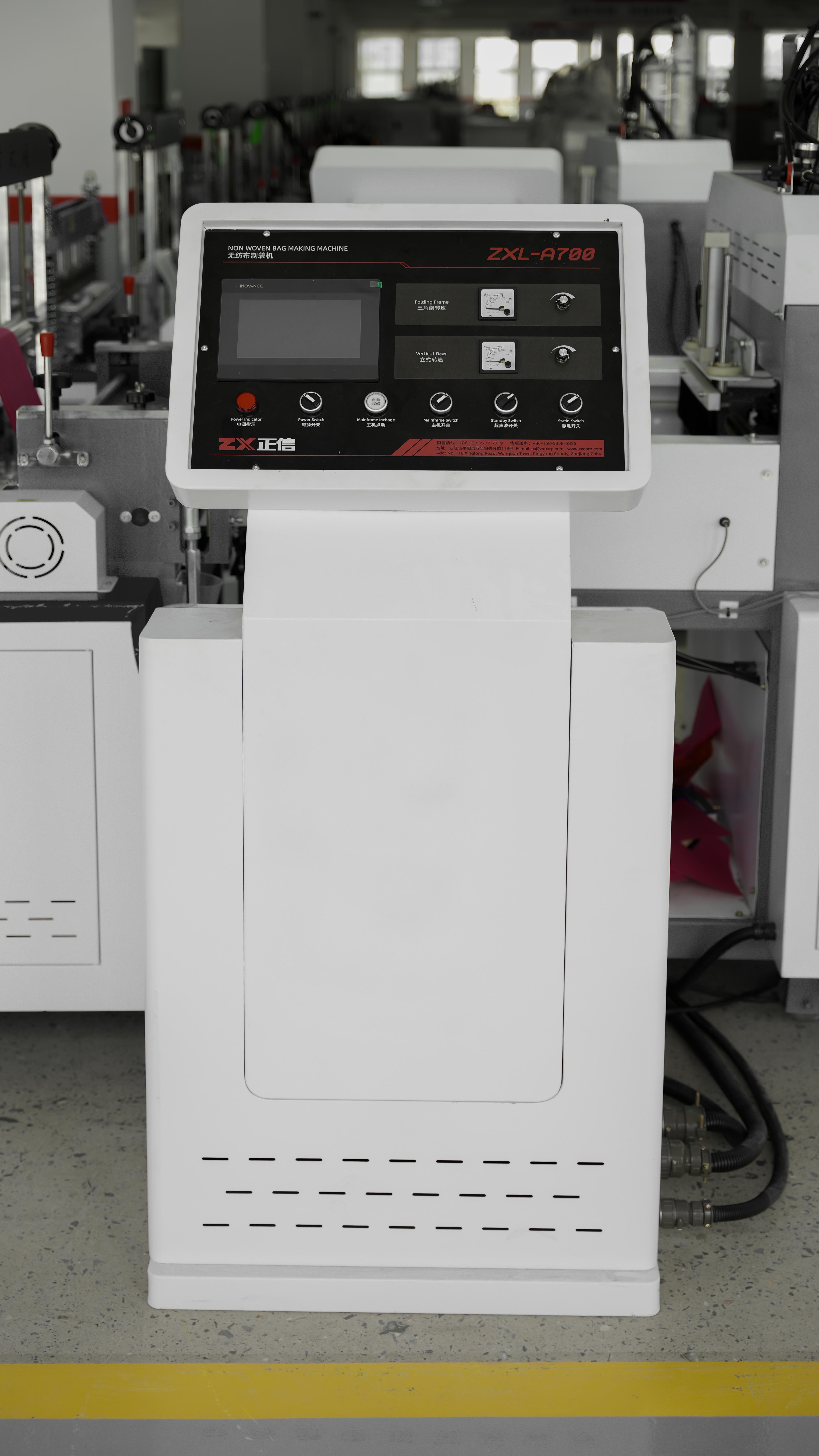
How to Choose a Non Woven Bag Making Machine: 5 Practical Steps
The following roadmap is designed for a first-time buyer moving from awareness to shortlist.
Step 1: Lock your primary bag type
Start with the bag your customers are most likely to order in volume. D-cut and W-cut bags are common entry points. Vest/T-shirt bags are among the most widely used non-woven formats globally. Box/3D bags serve premium retail and food delivery segments. If the primary format is uncertain, choose a multi-function machine that produces several styles. The ZXL-E700, for example, can produce over 20 bag types, including vest bags, drawstring bags, 3D bags, and zipper bags, and can specifically produce vest bags, box bags, loop handle bags, drawstring bags, and D-cut bags.
Step 2: Define daily output
Estimate realistic daily volume, then plan at 80–85% of rated speed rather than 100%. A machine rated at 100 pieces per minute produces roughly 4,800–7,200 pieces per hour at full speed, but shift logistics, material roll changes, and minor adjustments reduce actual output to about 32,000–49,000 bags per 8-hour shift. For a 100,000-bag daily target, typical configurations are three machines on a single shift or two machines on a double shift.
Step 3: Match the machine tier to the application
Zhengxin's product line is organized in tiers. The entry-level ZXL-B700 and ZXL-A700 are fully automatic workhorses for D-cut, W-cut, and vest bags. The ZXL-D700 and ZXL-E700 add online handle attachment and multi-style capability. The Ultra series (ZXL-A700Ultra, ZXL-E700Ultra) adds no-waste-edge technology and ultrasonic sealing. The ZX-LT500, ZX-LT500V, and ZX-LT500Pro are dedicated to box/3D bags, with the Pro version reaching 120 pieces per minute for high-volume operations. The ZXL-G700 covers side gusset bags.
Step 4: Check site conditions and compliance
Non-woven bag machines require three-phase power. Common configurations are 380V/50Hz, 220V/60Hz, and 415V/50Hz. Confirm the exact voltage and frequency of the factory before ordering. CE certification covers the Machinery Directive, Low Voltage Directive, and EMC Directive, enabling customs clearance in the EU, Middle East, Africa, and 30+ other countries that accept CE marking. Additional destination-specific certifications such as SONCAP, PVOC, or SASO may be required. The manufacturing facility itself should hold ISO 9001:2015 certification to support consistent quality control.
Step 5: Plan auxiliary equipment and total budget
Beyond the main machine, a professional setup typically needs four categories of auxiliary equipment: a fabric slitting machine to cut master rolls to bag width, an industrial screw air compressor with air dryer and tank, a voltage stabilizer/AVR in markets with unstable grid power, and fabric roll handling equipment for rolls weighing 200–500 kg. For a single-machine setup, essential auxiliary equipment is typically $8,000–15,000, which should be included in the initial investment calculation. An automatic counting and bundling machine and an inkjet date coder are recommended additions for supermarket supply contracts.
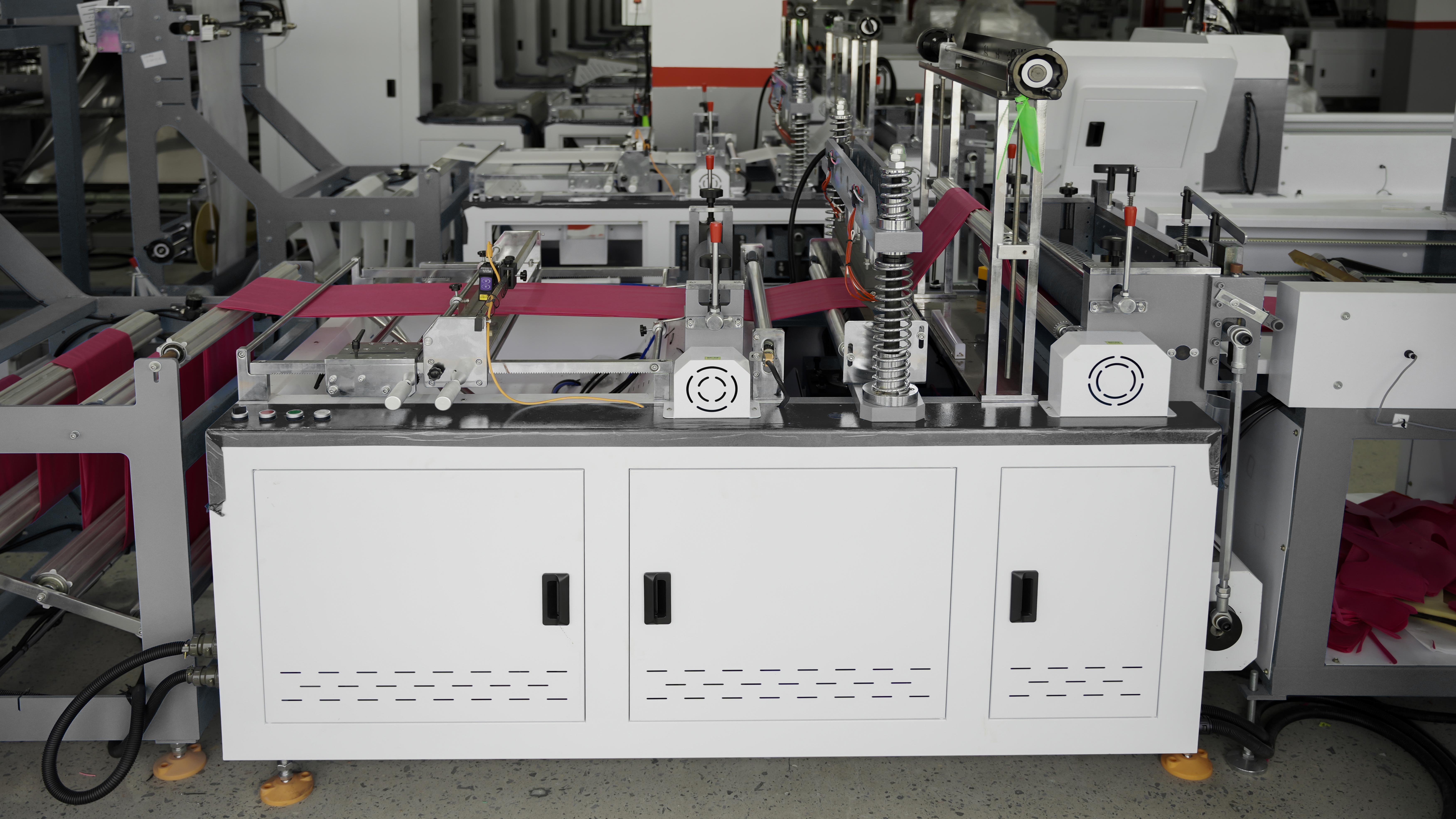
Production Scenarios and Machine Fit
Different industries impose different requirements on the machine. The following scenarios show how application needs map to equipment choices.
Retail and supermarket chains
Supermarket supply requires high speed, consistent seal quality, multi-color logo printing, and low defect rates. A typical configuration pairs the ZXL-A700Ultra with a 4-color flexo printing unit. The line produces finished printed shopping bags in one continuous process, with servo-driven cutting maintaining dimensional accuracy at full speed.
Garment and fashion retail
Garment packaging requires clean, wrinkle-free surfaces and soft fabric-like handle feel. The ZXL-A700 series, combined with a flexo printing unit, is a common configuration for logo-printed garment dust covers and shopping bags. Ultrasonic or heat sealing is selected based on whether the end customer requires food-grade or standard packaging.
Food delivery and takeaway
Food applications demand odorless, non-toxic sealing and clean production conditions. Ultrasonic welding is the preferred sealing method because it creates no burnt-fabric odor. The ZX-LT500 and ZXL-E700/Ultra series are suitable options for food takeaway bags, bakery packaging, and delivery platform orders.
Promotional products and corporate gifts
Promotional bag production requires quick job changeover and high print registration accuracy. A multi-color flexo printer combined with a versatile bag machine allows small-to-medium batches of branded tote bags with minimal setup time.
Non Woven Bag Making Machine Comparison
The following tables map bag types to machine models and summarize key specifications across the Zhengxin line.
| Bag Type | Recommended Machine Models |
|---|---|
| D-cut | ZXL-B700, ZXL-A700, ZXL-A700Ultra |
| W-cut | ZXL-A700, ZXL-A700Ultra |
| T-shirt / vest | ZXL-A700, ZXL-A700Ultra |
| Drawstring | ZXL-B700 |
| Flat bag with online handle | ZXL-D700 |
| Box / 3D with online handle | ZXL-E700, ZXL-E700Ultra |
| Side gusset with online handle | ZXL-G700 |
| Box / 3D standing bag | ZX-LT500, ZX-LT500V, ZX-LT500Pro |
| Model | Primary Bag Styles | Speed (pcs/min) | Fabric Roll Width | Total Power | Weight |
|---|---|---|---|---|---|
| ZXL-B700 | D-cut, drawstring | 40–120 | 500–1300 mm | 12 kW | 2200 kg |
| ZXL-A700 | T-shirt, W-cut, vest | 40–120 | 500–1300 mm | 15 kW | 2900 kg |
| ZXL-A700Ultra | T-shirt, W-cut, vest, zero trim | 40–120 | 500–1300 mm | 15 kW | 2900 kg |
| ZXL-D700 | 4-in-1 flat bag with online handle | 40–120 | 500–1300 mm | 15 kW | 3200 kg |
| ZXL-E700 | 5-in-1 box bag with online handle | 40–120 | 500–1300 mm | 18 kW | 4000 kg |
| ZXL-E700Ultra | 5-in-1 box bag with online handle, zero trim | 40–120 | 500–1300 mm | 18 kW | 4000 kg |
| ZXL-G700 | Side gusset bag with online handle | 60–100 | 500–1150 mm | 18 kW | 4200 kg |
| ZX-LT500 | Box / 3D bag, soft loop handle | 60–100 | 550–1160 mm | 50 kW | 9500 kg |
| ZX-LT500V | 3D box bag, vertical folding | 60–80 | 550–1160 mm | 50 kW | 12000 kg |
| ZX-LT500Pro | High-speed box / 3D bag | 60–120 | 550–1160 mm | 60 kW | 10000 kg |
Specifications are based on the manufacturer's published data. Speed varies with bag height, width, material GSM, and whether inline printing is active.
Frequently Asked Questions
What should I know before buying a non woven bag making machine?
Confirm your local voltage and frequency (all industrial machines require three-phase power), required daily output, bag styles needed, printing requirement, and destination country certifications such as CE, SONCAP, PVOC, or SASO. Standard lead time is 25–35 working days for production plus 15–45 days for sea freight. Payment terms are typically 30% deposit and 70% before shipment. Always conduct a live video factory tour before ordering and hire third-party pre-shipment inspection to verify the machine before final payment.
What is the difference between your machine models?
Zhengxin's product line is organized into tiers. The ZXL-B700 and ZXL-A700 are fully automatic entry-level machines for D-cut, W-cut, and vest bags. The ZXL-D700 and ZXL-E700 add online handle attachment and produce flat or box bags respectively. The Ultra series adds no-waste-edge technology and ultrasonic sealing, reducing fabric waste by 3–5%. The ZX-LT500 platform is a dedicated high-end machine for 3D box bags starting at a higher price point. The ZXL-G700 is a specialized side gusset machine. Choosing the right model depends on your primary bag type, daily output target, and raw material cost sensitivity.
What is ultrasonic welding? How does it seal non-woven bags?
Ultrasonic welding uses 20,000 Hz high-frequency sound vibrations to fuse polypropylene fabric layers together. A metal tool called a horn vibrates against the fabric, generating enough friction heat at the contact point to melt PP fibers within 0.2–0.5 seconds. When the vibration stops, the melted fibers cool into a permanent molecular bond. No glue, thread, or external heat source is used. Ultrasonic welds are 15–20% stronger in pull tests than heat-sealed seams, consume 25–30% less energy, and produce no scorching or odor, which is why the technology is essential for food-grade and medical bag applications.
What GSM should I choose for shopping bags?
GSM stands for grams per square meter. For shopping bags, 60–70 GSM is standard for lightweight retail bags, 80–90 GSM is the industry standard for supermarket shopping bags that carry 5–8 kg of groceries and can be reused 50+ times, and 100–120 GSM is for premium or luxury brand bags. Ultra-light 30–50 GSM fabric is typically used for disposable applications like garment dust covers. Always specify GSM when ordering fabric, because two rolls that look identical can differ significantly in strength and cost.
How long does delivery actually take?
Standard lead time is 25–35 working days for standard models and 35–45 days for customized configurations. Sea freight adds 15–45 days depending on destination, such as about 15 days to Indonesia, 25 days to Kenya, 35 days to Nigeria, and 40 days to Brazil. Total time from order to arrival is typically 45–80 days. To protect against supplier delay, request a written production schedule with milestone dates, include a penalty clause of around 0.5% per week of delay capped at 5%, and ask for weekly production update photos or videos.
Next step: build your shortlist. If you are evaluating non-woven bag making machines for a new or expanding production line, the fastest way to compare configurations is to request the latest catalog and talk through your volume and bag type with an applications engineer.
Contact Jayn: info@zxcorp.com | Tel / WhatsApp: +86 158-5888-9595
Download the Zhengxin company brochure: 2026 Zhengxin Machinery Catalog (PDF)
Have Questions or Need More Details?
Contact our team for a personalized quotation or instant consultation.
Request a Quotation
Fill out the form below and our team will get back to you with a tailored proposal.
WhatsApp Direct Chat
Prefer to chat in real-time? Message us on WhatsApp for instant assistance & quick answers.
- Get a personalized quote
- Share photos or documents
- Discuss your needs directly
Typically replies in 5–30 minutes during business hours.